

Silvan Dezini
Vivaldi & Müller
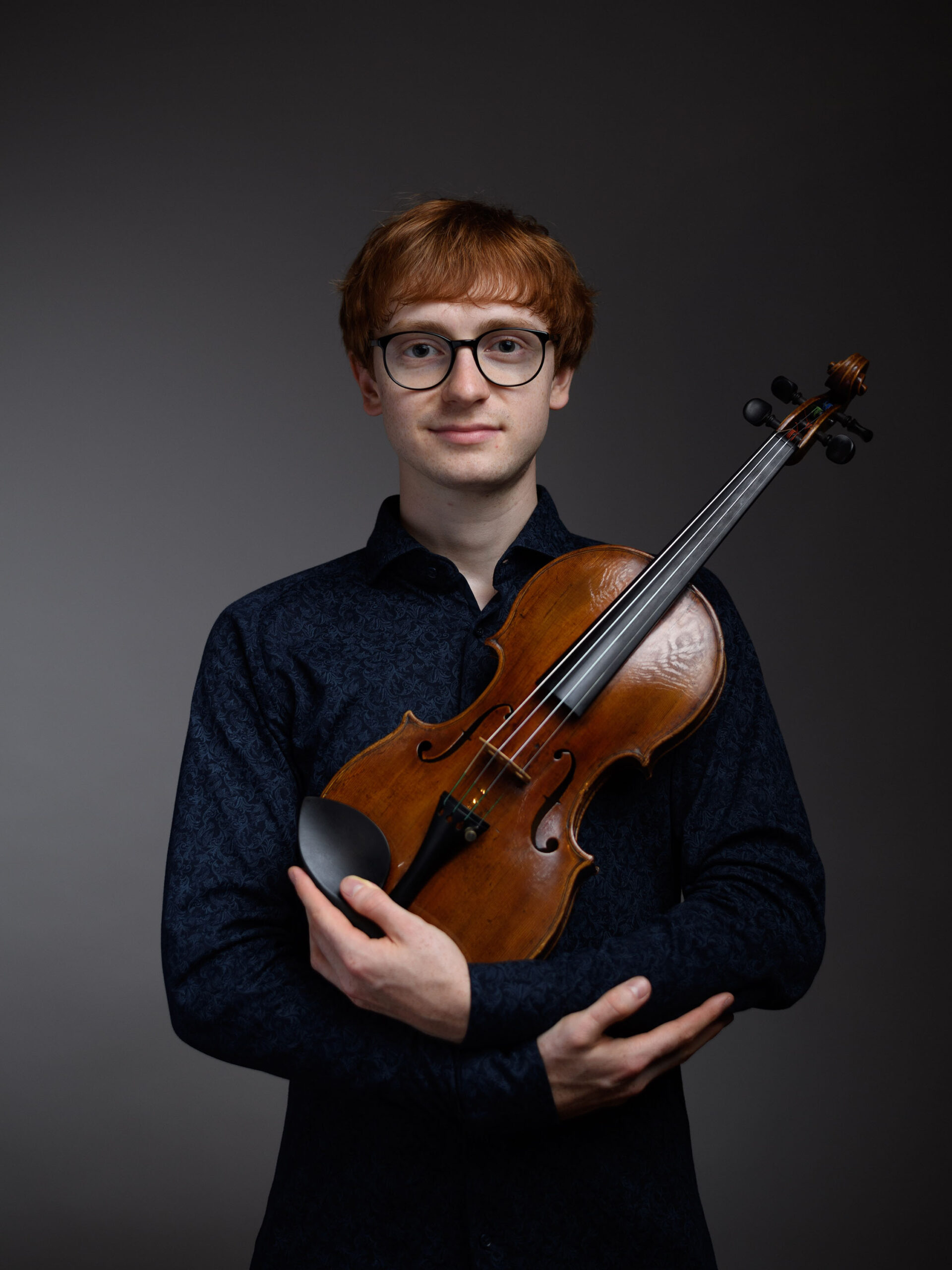
Photo: Valentin Luthiger

“Silvan Dezini’s music is disarmingly honest while at the same time letting you drift into the wildest dreams.”
Irene Hung-König, Limmatwelle
Vivaldi and Müller
Fabian Müller: Prelude – Spring | Vivaldi: Concerto No. 1 “La Primavera” in E major, Op. 8/1 | Fabian Müller: Intermezzo I – Summer | Vivaldi: Concerto No. 2 “L’Estate” in G minor, Op. 8/2 | Fabian Müller: Intermezzo II – Autumn | Vivaldi: Concerto No. 3 “L’Autunno” in F major, Op. 8/3 | Fabian Müller: Intermezzo III – Winter | Vivaldi: Concerto No. 4 “L’Inverno” in F minor, Op. 8/4 | Vivaldi: Sonata in D minor “La Follia,” Op. 1/12
Silvan Dezini: violin & artistic direction
Fabian Müller: composition
Ostinato Ensemble: Sebastian Bohren (violin) | Yumiko Huguenin-Dumittan (violin) | Markus Fleck (viola) | Andreas Fleck (violoncello) | Catalina Paredes (double bass) | Reymond Huguenin-Dumittan (theorbo) | Naoko Matsumoto (harpsichord)
What happens when 24-year-old violinist Silvan Dezini and 60-year-old composer Fabian Müller decide not simply to record Vivaldi’s most frequently performed work anew, but to question it through contemporary interventions? The answer lies in this exceptional production, which juxtaposes the most famous piece of Baroque program music with four newly composed works.
Vivaldi’s Four Seasons—arguably the most popular classical work of all time alongside Beethoven’s Fifth and Mozart’s Eine kleine Nachtmusik—has inspired generations of composers to create arrangements, reinterpretations, and homages. Fabian Müller takes a new approach: he composed a Prelude and three Intermezzi that precede Vivaldi’s four concertos, while leaving the originals entirely intact. Müller’s pieces, written in 2016 for the Murten Classics Festival, unfurl a “red carpet” for Vivaldi’s works, as the composer describes them: contemporary commentaries that enrich the concertos.
“Fabian Müller tells the Four Seasons from today’s perspective,” says soloist Silvan Dezini, describing a process in which Vivaldi’s music is infused with surprising stylistic elements developed over the last 300 years. Yet the evocative, atmospheric dimension remains a shared foundation. Certain scenes—scorching heat, biting cold, birdsong, drunken peasants—appear in both composers’ work, and in the new pieces they are expressed even more intensely than in Vivaldi.
While Vivaldi’s famous cycle is already designed to showcase spectacular violin virtuosity, the new Intermezzi also devote themselves to a virtuosic and at times expressively charged arc of tension that challenges Dezini on his instrument. The Prelude to Spring begins on the low G string with cascading triads and develops wild and elegiac dance figures before dissolving into a soundscape over which the violin imitates birdsong. Then, without pause, Vivaldi’s Spring Concerto begins—and suddenly one recognizes the tremolo strings, the layered textures of the pastoral middle movement, and the shepherds’ dances that Müller has already anticipated.
Each of the three Intermezzi foreshadows the atmosphere of the following Vivaldi concerto: the Summer Intermezzo evokes paralyzing heat and rumbling thunder rather than Alpine idyll; the Autumn Intermezzo condenses Vivaldi’s rustic harvest festivities into a waltz-like character and prefigures the stomping hunting rhythms. The Winter Intermezzo is the most independent: it begins with the same notes as Vivaldi’s Winter Concerto but transforms into a dark and mysterious meditation in which harpsichord cascades trace the crackling of ice crystals. “Fabian Müller’s pieces flow seamlessly into Vivaldi’s concertos, building a bridge between today and the past,” Dezini says of the listening experience. These fluid transitions show that three centuries are not an uncrossable divide, but rather a continuous musical evolution.
For Dezini, the project offered a refreshing re-immersion in the Four Seasons, which have become a biographical constant for him. He first studied them at age twelve at the Zurich Conservatory of Music. In 2022 he founded the “Ostinato Concerts” series in Wettingen, where he presented the full cycle. The Ostinato Ensemble emerged from this concert series. On this recording, the ensemble’s slender, remarkably flexible sound impresses not only through its solid string foundation and the theorbo’s shimmering arpeggios. The artistic calibre of the experienced musicians assembled here matches that of the soloist and, with historically informed continuo playing, brings a rich palette of colors from below.
As an “encore” to this cross-epochal project, the recording features another Vivaldi classic: the Sonata La Follia, a set of 19 variations on this originally Portuguese dance. While Arcangelo Corelli’s famous model (Op. 5, 1700) was conceived for solo violin and continuo, the young Vivaldi chose a trio setting five years later—resulting in a virtuosic dialogue between two violins and basso continuo. La follia—“merriment” or “madness”—fits perfectly into a program that dissolves boundaries between eras. Like the seasons, it returns again and again, offering abundant space for the unexpected within continuity.
Fabian Müller (b. 1964) is one of the most distinguished voices in contemporary Swiss music. His works have been premiered by David Zinman, Andris Nelsons, Christopher Hogwood, Steven Isserlis, and Dame Evelyn Glennie, and performed in Carnegie Hall, the Elbphilharmonie, the Tonhalle Zurich, and the Teatro Colón. In 2024 he was nominated for an OPUS Klassik Award as “Composer of the Year,” and in 2016 he received the Swiss Music Prize. He directs festivals, writes for music theatre, and is active in folk music. His opera EIGER (2021/22) was met with great acclaim, as was his family opera Heidi und das Weihnachtswunder (2022/23).
Silvan Dezini grew up in Spreitenbach and began playing the violin at the age of seven. The 24-year-old has won multiple first prizes in competitions and performed with the Bavarian Philharmonic and the Franz Schmidt Chamber Orchestra. He has played with Sebastian Bohren and the Aargau ensemble CHAARTS, and attended masterclasses with Igor Ozim, Ana Chumachenko, and Ingolf Turban. After completing his Bachelor’s degree with Andreas Janke at ZHdK, he is now pursuing a Master’s in Music Education with Bartek Niziol in Bern. He plays a violin by the Milanese Grancino family from a Swiss private collection and serves as artistic director of the Ostinato Concert Series in the canton of Aargau.
Ostinato Ensemble – The ensemble emerged from the “Ostinato Concerts,” founded in 2022 by Silvan Dezini in Wettingen, and performs in various formations depending on the repertoire. Performers on this recording include Sebastian Bohren (violin), Yumiko Huguenin-Dumittan (violin), Markus Fleck (viola), Andreas Fleck (violoncello), Catalina Paredes (double bass), Reymond Huguenin-Dumittan (theorbo), and Naoko Matsumoto (harpsichord). Together, they form a top-tier chamber ensemble of professionals and emerging musicians.